


Why Water Pipes in Victorian Houses Fail

Water pipe replacement for victorian houses starts with understanding why the originals give out.
Victorian terraces were built fast and cheap: lead for the supply, cast iron for the waste.
At External Moling Services Ltd, we have over 20 years of experience replacing water supply pipes across London and Southeast England.
The warning signs are rarely subtle:
Brown or discoloured water from cold taps
A metallic taste in drinking water
Damp patches on walls or floors
If two or more apply, your pipework needs a proper inspection.
Pipe Materials You Will Find in Period Homes
Victorian properties typically contain four pipe materials, each failing differently and needing a different replacement approach.
Lead pipes served most supply lines before the mid-20th century. Lead leaches into standing water, which is why the Drinking Water Inspectorate guidance on lead in drinking watertreats it as a health concern.
Galvanised steel replaced lead in some homes. It rusts internally, narrowing the bore until flow drops to a trickle.
Cast iron handled waste and drainage. It cracks under ground movement and corrodes at joints.
Copper appears in later retrofit work. It lasts well but can pinhole in soft water areas.
How to Inspect Old Pipework Before You Commit
A proper inspection answers three questions: what material is it, what condition is it in, and how much needs replacing?
Look for:
Grey, soft metal that marks easily (lead)
Rust-coloured joints or flaking (galvanised steel)
Green staining around fittings (copper corrosion)
A CCTV drain survey shows the inside of waste pipes without digging, while a pressure test reveals hidden supply leaks.
Watch OutNever assume a pipe is fine because the water runs clear. Lead contamination is invisible, tasteless and odourless in most cases. A clear supply does not mean a safe one.
Get the inspection in writing, with photos. You will need it for quotes and for any future sale.
Signs of Lead Water Pipes in a Victorian Property
Lead pipe identification is straightforward: the signs of lead water pipes are physical, and you can check most yourself.
Look where the pipe enters your home, usually under the kitchen sink or in a front garden stopcock chamber.
Other giveaways:
Bulging joints where two lengths were wiped together
A pipe that bends easily by hand
White powdery deposits near joints
If you find lead, do not panic.
Water UK's advice on lead pipe replacement is clear that replacing the supply pipe is the only permanent solution.
Pressure, Drainage and Soil Pipes on Upper Floors
Upper floors in Victorian homes create two plumbing problems: getting water up, and getting waste down.
Pressure drops on upper floors because old supply pipes narrow with corrosion and gravity works against you, a four-storey house with a corroded lead riser will always struggle at the top.
Drainage has its own issues. Soil pipes in period homes are often cast iron, hidden inside wall cavities or boxed in behind panelling.
Common upper-floor problems we see:
Toilets that flush weakly or back up
Slow drains in first-floor bathrooms
Damp patches on ceilings below bathrooms
The fix depends on the cause, a blocked soil pipe or a failed pipe needing replacement. A camera survey settles the question.
Pro TipIf only the top floor has pressure problems, the issue is usually the supply riser, not the mains. Replacing that single vertical run often solves it without touching the rest of the system.
Trenchless Water Pipe Replacement Explained
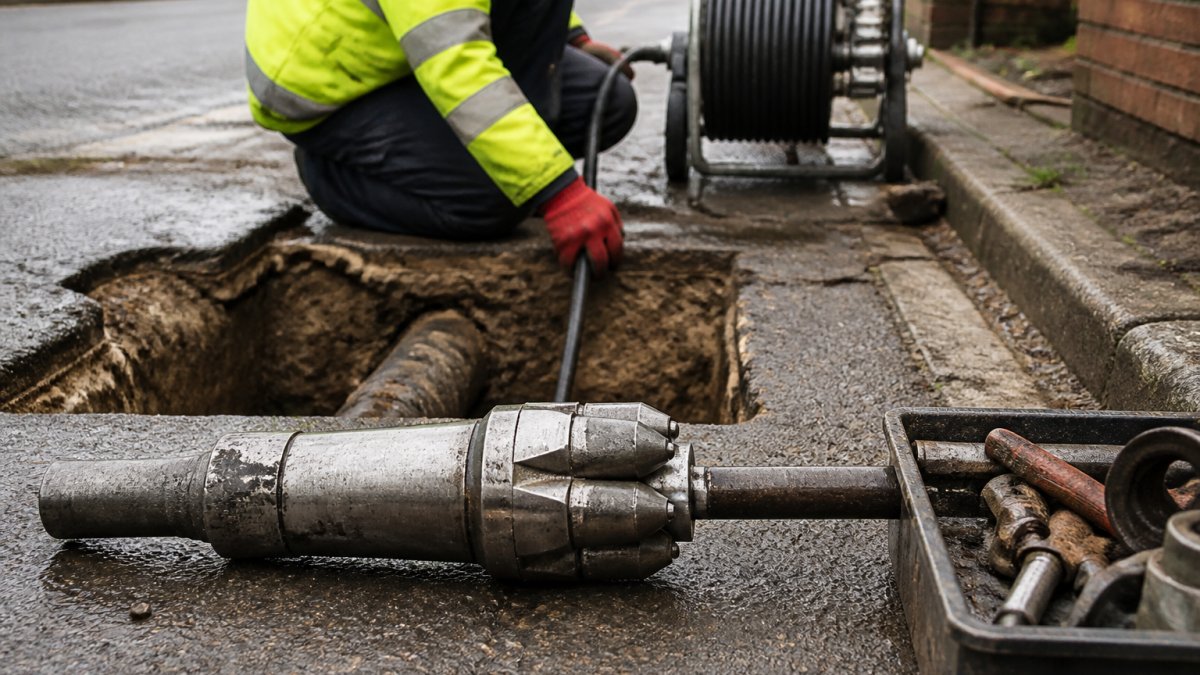
Trenchless water pipe replacementinstalls a new supply pipe by pulling it through a small excavation rather than digging a continuous trench. We use it at External Moling Services Ltd because it protects gardens, driveways and period features.
Here is how the process works, step by step:
Survey and locate. We trace the existing pipe route and mark entry and exit points.
Dig two small pits. One at the boundary, one at the property. Each is roughly the size of a paving slab.
Feed the moling head. A steel head is driven through the soil along the old pipe's path.
Pull the new pipe. The new supply line is attached and drawn through behind the head.
Connect and test. We join to the mains and internal stopcock, then pressure test.
Reinstate. Pits are backfilled and surfaces restored.
For a Victorian terrace, this means no trench across the front garden and no lifted patio. The whole job often finishes in a day.
MethodGround DisturbedTypical DurationBest ForTrenchless molingTwo small pits1 dayEstablished gardens, drivewaysOpen trenchContinuous trench2-4 daysClear ground, no landscapingPipe burstingTwo pits1-2 daysSame-size or larger replacement
Water Supply Pipe Replacement Cost and What Drives It
Water supply pipe replacement cost varies widely, and anyone quoting a flat figure without seeing your property is guessing. Here is how the money breaks down, so you can sanity-check any quote.
The cost drivers, in order of impact
Length of the run. The biggest factor. The pipe runs from the boundary (often the pavement stopcock or an external stop tap in the front garden) to your internal stopcock. A 6-10 metre Victorian terrace run is a very different job from a 25-metre semi.
Ground conditions. London clay is slow to dig but stable; made ground, rubble, old foundations and tree roots slow everything down, and concrete or block paving adds cutting and reinstatement cost.
Access. Can a moling rig and van reach both pits? A narrow shared alley between terraces, or a basement flat with no rear access, changes the method and labour hours.
Depth. Victorian supply pipes are often shallower than modern ones, which helps, but under a mature hedge, conservatory footing or boundary wall, the route may need re-planning.
Reinstatement. Gravel and soil are cheap to make good; block paving, tarmac, York stone flags and tiled paths are not. Ask what reinstatement is included.
Internal work. If the internal stopcock, riser or distribution pipework also needs replacing, that is a separate scope from the external supply pipe.
Indicative figures
As a rough guide for a typical Victorian terrace in England and Wales, a trenchless external supply pipe replacement commonly falls in the low thousands of pounds, driven mainly by run length, ground conditions and reinstatement. A short moled run under gravel sits at the lower end; a long run under block paving with internal re-routing sits well above it.
Treat any figure you see online, including this one, as a starting point, not a quote. Only a site-surveyed quotation matters.
What a good quote should itemise
Excavation and reinstatement of the entry and exit pits
The new pipe, fittings and stopcock
Connection to the water company's communication pipe at the boundary
Key TakeawayThe cheapest quote is rarely the cheapest job. Check what is included: reinstatement, testing, guarantee and making good. A low headline price often excludes the work that matters, and a quote that will not itemise is a quote you cannot compare.
Budgeting for the unexpected
On period properties, allow a contingency. Once the pits are open it is common to find the old pipe shares a route with a redundant drain, gas service or root system. A reputable contractor will flag this and give you the variation cost in writing, if they will not, walk away.
Water Pipe Replacement Duration and Managing Disruption
Water pipe replacement duration depends on the method and property. A straightforward trenchless supply pipe replacement usually takes one working day.
Larger jobs take longer:
Supply pipe only: typically one day
Supply pipe plus internal re-routing: one to two days
Full soil pipe replacement: two to three days
Disruption is the real concern for most homeowners, you need water back quickly.
How we limit disruption:
Water is usually off for a few hours, not the whole job
We work around your schedule where possible
Gardens and driveways are protected before work starts
For landlords, we offer 24/7 emergency call-out.
If you cannot be without water for a full day, tell us when you book. We can often stage the work to keep supply running.
Regulations, Permissions and Choosing a Contractor
Water supply pipe work in period homes is subject to rules, and getting them wrong can cost you. In England and Wales, the Water Industry Act 1991 sets out the framework for water supply and the pipework connecting your home to the mains. The Water Supply (Water Fittings) Regulations 1999 then govern the fittings and materials used inside the property boundary.
Who owns which pipe
Most homeowners get this distinction wrong:
The water company's pipe runs from the main in the street to your property boundary (often the external stop tap) and is usually theirs to maintain.
Your supply pipe runs from that boundary into your home, up to and including the internal stopcock. It is your responsibility, and the pipe that usually needs replacing in a Victorian house.
If a leak is on the water company's side, they fix it. If it is on yours, it is your job and your cost.
What the regulations require
No lead in any new installation. Lead supply pipes must be replaced, not repaired, when work is carried out.
Materials and fittings must be approved for potable water, a plumber cannot simply use whatever is on the van.
Notification. Some work, including supply pipe replacement and certain fitting changes, must be notified to your water company in advance. They can inspect and, if it does not comply, require it redone at your cost.
If your property is listed or in a conservation area, separate consent may be needed for external works affecting its character, check with your local planning authority before work starts.
Choosing a contractor
Look for:
Membership of an approved contractor scheme recognised by water companies
Public liability insurance and, where relevant, employer's liability insurance
A written labour guarantee with the period stated
How to verify a contractor before you book
Ask for their approved contractor scheme membership number and check it with the scheme.
Ask which water company they will notify, and confirm they will handle it.
Ask for the guarantee in writing, including what it covers and what voids it.
At External Moling Services Ltd, we are an approved water board company with fully qualified, fully insured engineers. Every water main replacement and repair carries a 10-year labour guarantee.
That guarantee is not a marketing line. It covers our workmanship if a pipe we installed fails.
Watch OutNever use an unregistered contractor for supply pipe work. If the installation does not meet the water fittings regulations, your water company can require it to be redone at your cost, and you may have no practical comeback against the original installer.
After the work is done
Keep the paperwork. A completion certificate, pressure test record and guarantee document are useful if you sell, as buyers' solicitors increasingly ask for evidence that supply pipe work was done to standard. If the work was notifiable, keep the water company's response too.
Frequently Asked Questions
How can I tell if my Victorian house has lead water pipes?
Check the pipe where it enters the property, often under the kitchen sink or in a front garden stopcock chamber. Unpainted lead is dull grey and soft enough to mark with a coin or key; scratching it reveals a shiny silver surface. If you are unsure, a plumber or your water company can confirm the material.
How much does water pipe replacement for Victorian houses cost?
Water supply pipe replacement cost depends on run length, ground conditions, access, whether the driveway or garden must be reinstated, and whether the work is trenchless or open trench. Hard surfaces, mature trees and shared supply arrangements all add complexity. Because every period property is different, ask for a written, itemised quote after a site survey rather than relying on a general figure, and confirm what is included for reinstatement.
Can a water supply pipe be replaced without digging up the garden?
Often, yes. Trenchless water pipe replacement uses moling or directional drilling to pull a new pipe along the old route from small launch and reception pits, typically around one square metre each. This suits many Victorian terraces where the supply crosses a front garden, path or driveway. Very shallow pipes, sharp bends or collapsed sections may still need limited excavation, and the contractor should confirm feasibility after a survey.
How long does it take to replace a water supply pipe?
Water pipe replacement duration for a typical terrace run is usually one to two days, with the new supply connected and water restored the same day in most cases. Longer runs, hard ground, shared supplies or significant reinstatement can extend this.
Replacing water pipes in a Victorian house is not a job to put off. Lead and corroded iron get worse, never better, and the damage they cause to your home and your health grows with every year. At External Moling Services Ltd, we bring over 20 years of trenchless moling experience, 24/7 availability, and a 10-year labour guarantee to every job. Get your free quote and find out how quickly we can replace your old pipework with minimal disruption to your home.


Comments